
 Welcome to EnviroDIY, a community for do-it-yourself environmental science and monitoring. EnviroDIY is part of
@shicks
Active 3 days, 21 hours ago-

Shannon Hicks replied to the topic Mayfly USB Connection Problems in the forum Mayfly Data Logger 10 years, 5 months ago
The power switch on the Mayfly is a DPDT switch that has 2 functions. One pole switches the power input line to the main processor power rail, and the other other pole switches the power supplied to the FT232RL USB chip. So if there’s a defect in the switch mechanism on only one of the poles, it’s possible that the Mayfly will still power up and…[Read more]
-
Shannon Hicks replied to the topic Mayfly USB Connection Problems in the forum Mayfly Data Logger 10 years, 5 months ago
I’m not aware of any other issues with the power switch or USB connectivity. What operating system are you using? And did you buy the Starter Kit that comes with it’s own microUSB cable, or are you using your own cable? I’ve had connection issues with microUSB jack/cable combinations on other devices, so maybe try a different cable and see if…[Read more]
-
Shannon Hicks posted a new activity comment 10 years, 5 months ago
On the top of the board near the FTDI header there’s an unpopulated 2-pin header for an Aux 5v input. Most people won’t use it, but I put it there for the experienced users who want the flexibility of different power options. I’ve been powering several boards like that lately, I’ll try to write about it on the Hardware section of the support…[Read more]
-
Shannon Hicks posted a new activity comment 10 years, 5 months ago
We are aware of the availability issue for customers outside North America and are looking into different options for international sales.
-
Shannon Hicks posted a new activity comment 10 years, 5 months ago
The boards are now available on Amazon: http://envirodiy.org/mayfly-boards-now-available-on-amazon/
-
Shannon Hicks wrote a new post 10 years, 5 months ago
Mayfly boards now available on Amazon
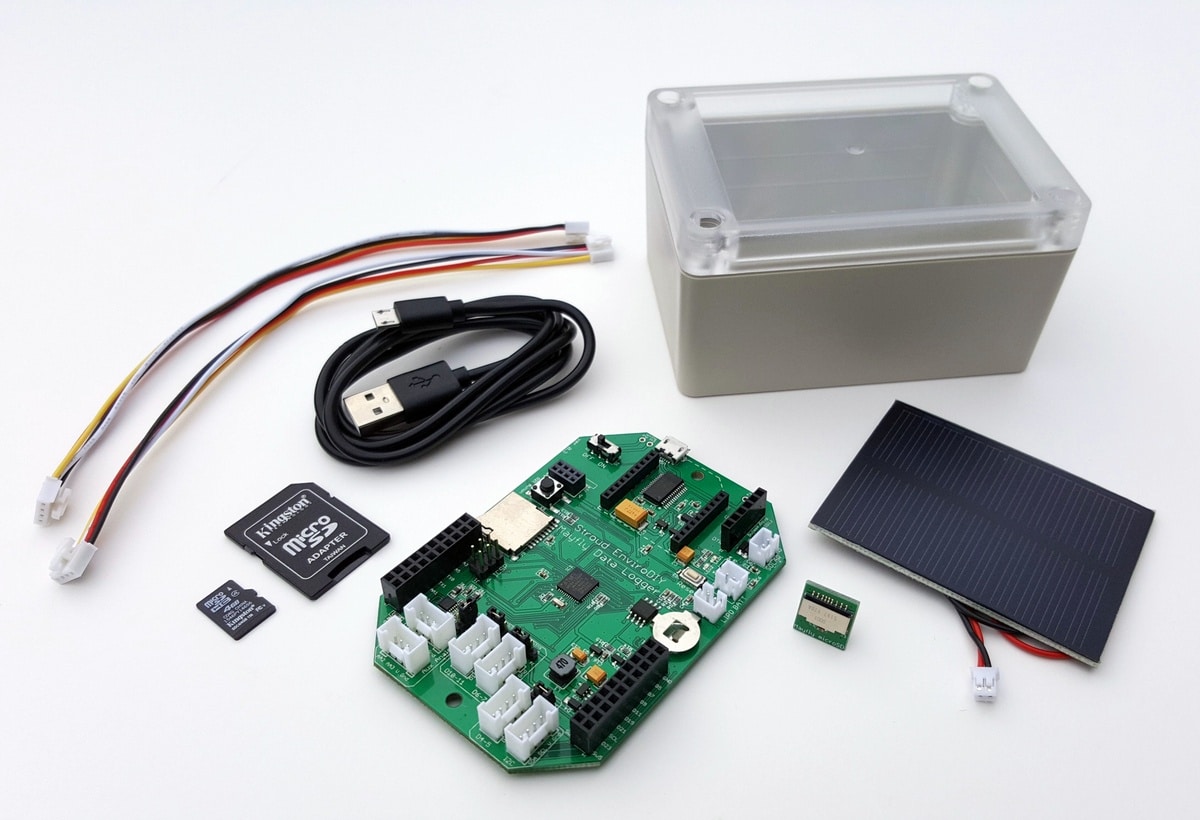 Update: We have closed our Amazon shop. See the EnviroDIY Shop for current availability. We are excited to announce that our Mayfly Data Logger boards […]
-
Shannon Hicks posted a new activity comment 10 years, 6 months ago
Good news – the boards finally arrived a few days ago, I’m now working on getting everything ready for the online sales, details to follow shortly!
-
Shannon Hicks posted a new activity comment 10 years, 6 months ago
We’re still waiting for the first big manufacturing run to get delivered. Once it does, we’ll get it to the distributor as soon as we can. In the meantime, we’ve been working on documentation and instructions, so look for postings that info on this site early next week.
-
Shannon Hicks posted a new activity comment 10 years, 7 months ago
What’s shown in the photo is a basic analog-output pressure transducer made by Keller-America. It’s been awhile since I checked the price on them, and the ones we used were part of a deeply discounted surplus lot. I think they are usually around $300 or higher, depending on the precision and type of output signal.
-
Shannon Hicks posted a new activity comment 10 years, 7 months ago
The board we used in the photos (Seeeduino Stalker 3.2) isn’t available anymore. I have a colleague who was going to post a full writeup tutorial for this ultrasonic logger build, but since no one can replicate it due to the obsolete hardware, it got put on hold. Once the new Mayfly board is available (very, very soon), we can do a tutorial of…[Read more]
-
Hey,
I have ordered an Seeduino v2.3, Maxbotix 7389 and a gprsBee rev. 6. Then I found this page ,-)
Nice to see, that these three parts are already in use together …Steve, could you please provide some more information about your setup and software?
Thanks, AnselmPS: The stalker v2.3 was still available somewhere in china with the…[Read more]
-
We have been field-testing various configurations of the ultrasonic station and wanted to be sure we had the best design before publishing the instructions. Some colleagues and I are having a build session later this week where we will be assembling several Mayfly ultrasonic sensor stations, and our goal is to make a tutorial out of the photos…[Read more]
-
I’ve been lurking here for sometime, but have just had to sign up! I’m based in the UK and am looking into creating a similar water depth sensor here – I can’t buy the Mayfly as Amazon.com won’t ship it to the UK and its not available on .co.uk unfortuntely 🙁
I just wanted to know though, are you working on the writeup for the Mayfly board?
-
-
Shannon Hicks posted a new activity comment 10 years, 8 months ago
What’s the supply voltage (Vcc) of this board? I’m wondering if you designed it for a 5-volt I2C bus like the Uno, or if it’ll work with 3.3v systems, like the Mayfly or Raspberry Pi.
-
These are all 3.3V I2C sensors.
-
Distance is possibly an issue if the wiring to logger isn’t short. For the enclosure application, I thought about dropping a small teensyLC in the base with TTL/RS232 interface so that a serial connection could be made from enclosure to logger. Teensy would handle all the sensor data requests and then just feed a csv over TTL or RS232 depending on…[Read more]
-
-
-
Shannon Hicks posted a new activity comment 10 years, 8 months ago
They are being manufactured right now, but we can’t announce availability and online store info until everything is finalized. There was a slight slowdown in the process due to the holiday in China and its effect on the supply chain, but we’re still hoping to have them for sale very shortly.
-
Shannon Hicks posted a new activity comment 10 years, 9 months ago
Here’s an update for everyone wondering about the board availability. We went through one more round of design updates to add some extra features like an onboard FTDI-USB chip and a 5-volt boost regulator to generate 5v for any sensors or devices you want to power. The final Mayfly production run should be ready for purchase at an online…[Read more]
-
Can’t wait….Can you tell us which online retailer ? The 5V boost will be really useful. I’m using several Mbili with power boost to 5V to power long 1-wire sensor bus.
-
They are being manufactured right now, but we can’t announce availability and online store info until everything is finalized. There was a slight slowdown in the process due to the holiday in China and its effect on the supply chain, but we’re still hoping to have them for sale very shortly.
-
The boards are now available on Amazon: http://envirodiy.org/mayfly-boards-now-available-on-amazon/
-
-
Any update on Mayfly availability? Thanks!
-
And a second request for update…desperate to get my hands on one (or more)…
-
We’re still waiting for the first big manufacturing run to get delivered. Once it does, we’ll get it to the distributor as soon as we can. In the meantime, we’ve been working on documentation and instructions, so look for postings that info on this site early next week.
-
-
-
-
Shannon Hicks wrote a new post 10 years, 10 months ago
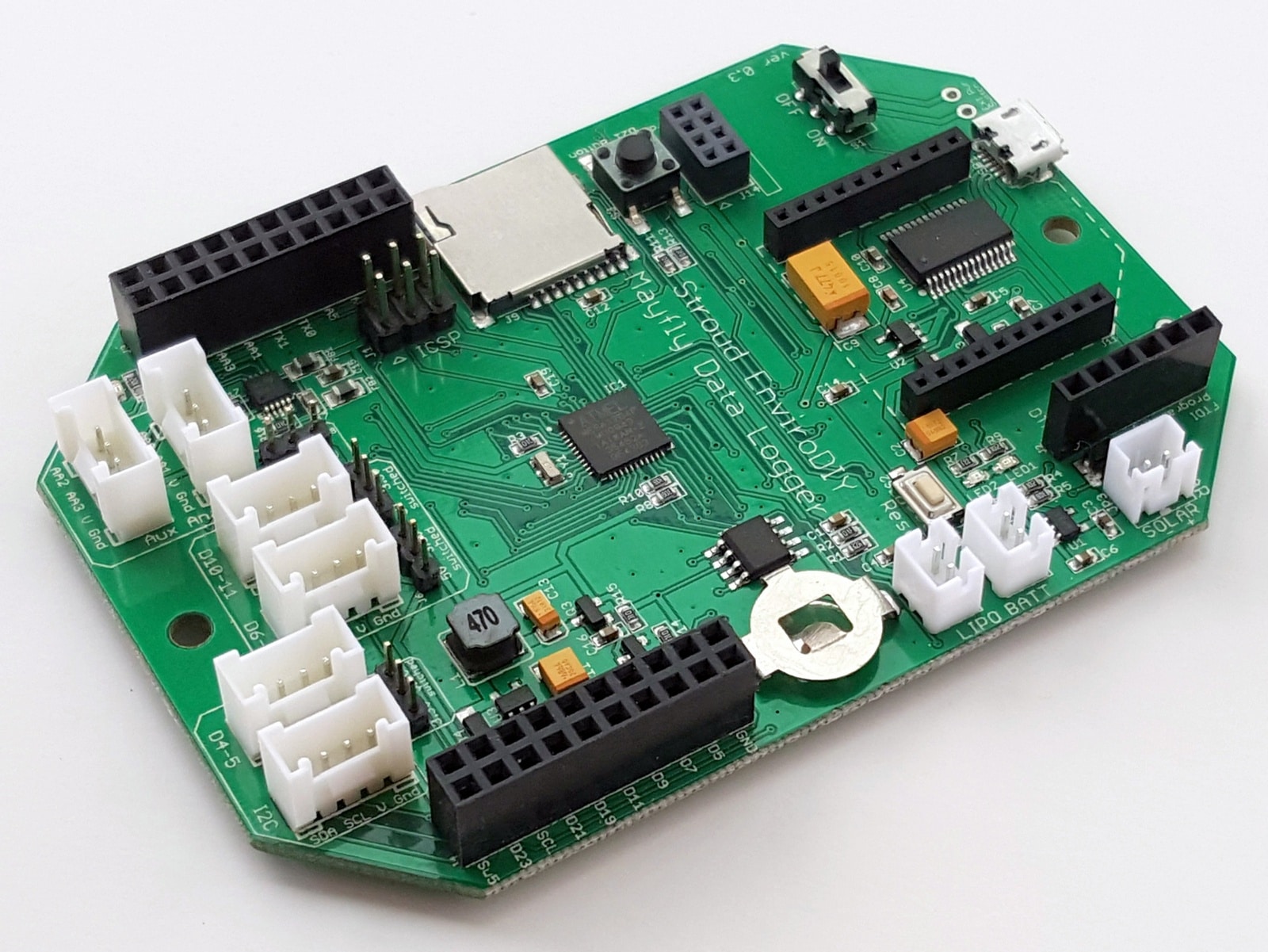
We are excited to introduce our new custom Arduino-based datalogger board, the EnviroDIY Mayfly Logger. It has a combination of features and capabilities that make it one of the most powerful and flexible logger […]
-

This is great news. I have just started an investigation into low cost and/or open source data loggers, partly in anticipation of a rolling program of hydrology data logger replacement and partly to promote / aid in citizen science and crowd sourced environmental data gathering. Very much looking forward to hearing more about this and hopefully getting to experiment a bit with it in 2016.
-
I agree with the previous post in that this is great news. I hope it is such that newbies can learn and implement in short order. I have long thought a basic logger capable of operating and recording water levels utilizing an ADC and current loop 4-20 mA transducers would be well received. I know I would like to be able to work with something on this line.
Most commercial options are far more complicated than necessary and far too expensive to allow for routine upgrade/replacement.
-

Nice to see. The adc seems to have a low Vref voltage drift – though needs to be calculated over the temperature of interest. For a 4-20mA need to be able to generate/switch ~15V to supply the sensor.
Should fit nicely with arduino. I’m wondering if there would be any interest in a instrument interface being RS485 with 12V and python for processing the serial stream? Seems like 20mA is a basic standard that is open by its simplicity, but if only there was something that could do the RS485.
-
I’m not sure if the questions regarding the 4-20mA circuit would be sufficed by something like this?
Very good info on using RS-485 with arduino platforms is located here:
-
I’ve also been experimenting with the SODAQ Mbili, so really interested in the Mayfly. How can we get hold on one (or more) ?
-

Hi @sroberts, we hope to have that information available very soon!
-
-
Here’s an update for everyone wondering about the board availability. We went through one more round of design updates to add some extra features like an onboard FTDI-USB chip and a 5-volt boost regulator to generate 5v for any sensors or devices you want to power. The final Mayfly production run should be ready for purchase at an online retailer in about a month from now (early March). More updates will follow soon.
-
Can’t wait….Can you tell us which online retailer ? The 5V boost will be really useful. I’m using several Mbili with power boost to 5V to power long 1-wire sensor bus.
-
They are being manufactured right now, but we can’t announce availability and online store info until everything is finalized. There was a slight slowdown in the process due to the holiday in China and its effect on the supply chain, but we’re still hoping to have them for sale very shortly.
-
The boards are now available on Amazon: http://envirodiy.org/mayfly-boards-now-available-on-amazon/
-
-
Any update on Mayfly availability? Thanks!
-
And a second request for update…desperate to get my hands on one (or more)…
-
We’re still waiting for the first big manufacturing run to get delivered. Once it does, we’ll get it to the distributor as soon as we can. In the meantime, we’ve been working on documentation and instructions, so look for postings that info on this site early next week.
-
-
-
-
Good news – the boards finally arrived a few days ago, I’m now working on getting everything ready for the online sales, details to follow shortly!
-
-
Shannon Hicks posted a new activity comment 10 years, 11 months ago
There are several different ways to trigger an ISCO sampler with an external source. We’ve found a few ways to do it with our Arduino-based loggers, it shouldn’t be too hard to program a Campbell logger to do the same. One way is to connect your logger to one of the 3 Programmable I/O pins on the ISCO’s rain gauge connector. By doing this, yo…[Read more]
-
Shannon Hicks replied to the topic Datalogger build in the forum Other Data Loggers 11 years ago
FWIW, in the past I’ve had a few times where the DS1307 clock on the Adafruit shield would reset to some random time in the past or sometimes even in the future. If I remember right, I think it usually happened whenever I was trying something new with the hardware, so I just assumed it was sensitive to shorts or other weird electrical gremlins.…[Read more]
-
Shannon Hicks posted a new activity comment 11 years, 1 month ago
I’ve had loggers out for several very cold winters now, and I haven’t had any issues with the LiPo batteries due to cold temperatures. The only times I’ve had problems was using them in clear enclosures during the summer because the inside of the case turns into a mini-greenhouse and heats up the batteries (and the logger boards), resulting in…[Read more]
-
Shannon Hicks posted a new activity comment 11 years, 4 months ago
Our Github site is already active, you can see it here: https://github.com/StroudCenter
But I haven’t written up a tutorial for this sensor display project yet. If you’re good with code and the LCD hardware, take a look at the SDI-12 library examples and you should be able to replicate it pretty easily.
-
Shannon Hicks posted a new activity comment 11 years, 6 months ago
The ADS1015 ADC has a programmable gain so I since I was looking at signals I knew were below 2v, I used the GAIN_TWO setting to give me a range of +/-2.048V. You can select anything from a gain of two-thirds to 16, which is a range of around 6v (but realistically Vcc of 5v for an Uno) down to 0.25v.
For accuracy, the error is supposedly less…[Read more]
-
Shannon Hicks wrote a new post 11 years, 7 months ago
A few months ago I was asked by a researcher here at the Stroud Water Research Center to come up with an automated way to measure the voltage of 8 fuel cells. The cells need to be electrically isolated from each […]

-
Hey nice article. Thanks for posting.
I’m curious – what sort of target voltages where you measuring and what measurement accuracy where you looking for? and over what temperature range. ?-
The ADS1015 ADC has a programmable gain so I since I was looking at signals I knew were below 2v, I used the GAIN_TWO setting to give me a range of +/-2.048V. You can select anything from a gain of two-thirds to 16, which is a range of around 6v (but realistically Vcc of 5v for an Uno) down to 0.25v.
For accuracy, the error is supposedly less than one LSB and very stable across the -40 to 120 degree operating range. Years ago I found that the Arduino’s on-board ADC is horribly inaccurate during either extremely hot or cold temperatures in the dataloggers we deployed outside, so we started using the ADS1015 in all of our loggers and have been extremely happy with their performance.
-
-
Nice – The ADS1015 handles a lot.
A lot of onboard ADCs need careful looking at – they are improving.
Numbers need confidence/traceability analysis, the errors typically need all adding, the Vref error, temperature drift error across temperature range, the ADC error, and then any external circuitry – so that was why I was curious as to how you were checking it out.
I’m on the Nerds4Natrure.org Maker Fair San Mateo May15 and going to be showing/discussing errors and traceability for depth measuring sensors
http://blog.nerdsfornature.org/post/115703686099/nature-nerds-maker-faire-2015
-
- Load More



Great to see these are now available. Unfortunately i’m in the UK and amazon doesn’t appear willing to ship this item internationally. Is there any likelihood that you will be able to ship internationally in the near future?
These look really promising. I second Davids comment though. I would very much like to test the Mayfly but Amazon are not allowing shipping to the UK.
We are aware of the availability issue for customers outside North America and are looking into different options for international sales.
Great! Looking forward to getting my hands on a couple of these.
A basic question about power:
Ideally, we would like to use 12V ~7aH AGM lead acid batteries to power the Mayfly instead of the 3.7V LiPo. We are planning to use the Mayfly for a pretty power intensive sapflux installation that requires small heaters to be powered directly off of 12V batteries. If we could use the 12V battery to also power the Mayfly that would be ideal.
1. Is it possible to power the Mayfly with a non LiPo battery? What about a voltage >3.7? I know that the Uno can accept 7-12V, but I don’t see an obvious Vin port in the pictures of the Mayfly.
2. I assume that the LiPo battery charging capabilities that are built in to the Mayfly are not suited for a Lead Acid AGM charging, correct? Do you have any suggestions for a low cost charge controller? We have used sunsavers in the past, but I’d love to hear any other suggestions.
Thanks!
On the top of the board near the FTDI header there’s an unpopulated 2-pin header for an Aux 5v input. Most people won’t use it, but I put it there for the experienced users who want the flexibility of different power options. I’ve been powering several boards like that lately, I’ll try to write about it on the Hardware section of the support page soon. The input voltage should not exceed 6v or certain components on the Mayfly could be damaged. While we could have included a regulator to handle higher voltages, it would require dissipating lots of heat, so in the interest of keeping things simple, we opted to limit the input voltage to 5v.
An easy way to power the Mayfly with a 12v battery would be to use a 12v-to-5v stepdown converter with microUSB plug. There are many of them on Amazon for around $10-15. They are commonly used for connecting power in cars for dashcams and GPS units. Some of them also have an inline power switch and/or a fuse. I’ve been using one with a 12v, 18ah SLA battery and it works great.
The charging circuitry on the Mayfly is only suitable for a lipo battery. You’ll need a completely different solar charge controller if you’re trying to charge a large capacity 12v battery. I can write more about that topic in another blog post that’s specifically about solar panels.
Neat! I’m looking forward to trying this out! I believe it will help me to get around some limitations of the proprietary logger I’m using and allow me to make sensor installations that would not be economically viable otherwise.
Is there any more info on availability in Europe ? Nothing on Sodaq website and I’ve emailed them but no response.
International sales options are complicated so we don’t have a option yet ,and I don’t have an estimate on when we might be able to announce something.