CloudFlare provides web performance and security solutions, enhancing site speed and protecting against threats.
Service URL: developers.cloudflare.com (opens in a new window)
cf_use_ob
The cf_use_ob cookie informs Cloudflare to fetch the requested resource from the Always Online cache on the designated port. Applicable values are: 0, 80, and 443. The cf_ob_info and cf_use_ob cookies are persistent cookies that expire after 30 seconds.
session
__cfwaitingroom
The __cfwaitingroom cookie is only used to track visitors that access a waiting room enabled host and path combination for a zone. Visitors using a browser that does not accept cookies cannot visit the host and path combination while the waiting room is active.
session
cf_chl_rc_i
These cookies are for internal use which allows Cloudflare to identify production issues on clients.
session
cf_chl_rc_ni
These cookies are for internal use which allows Cloudflare to identify production issues on clients.
session
cf_chl_rc_m
These cookies are for internal use which allows Cloudflare to identify production issues on clients.
session
__cfruid
Used by the content network, Cloudflare, to identify trusted web traffic.
session
__cf_bm
Cloudflare's bot products identify and mitigate automated traffic to protect your site from bad bots. Cloudflare places the __cf_bm cookie on End User devices that access Customer sites that are protected by Bot Management or Bot Fight Mode. The __cf_bm cookie is necessary for the proper functioning of these bot solutions.
session
__cflb
When enabling session affinity with Cloudflare Load Balancer, Cloudflare sets a __cflb cookie with a unique value on the first response to the requesting client. Cloudflare routes future requests to the same origin, optimizing network resource usage. In the event of a failover, Cloudflare sets a new __cflb cookie to direct future requests to the failover pool.
session
_cfuvid
The _cfuvid cookie is only set when a site uses this option in a Rate Limiting Rule, and is only used to allow the Cloudflare WAF to distinguish individual users who share the same IP address.
session
cf_clearance
Whether a CAPTCHA or Javascript challenge has been solved.
session
__cfseq
Sequence rules uses cookies to track the order of requests a user has made and the time between requests and makes them available via Cloudflare Rules. This allows you to write rules that match valid or invalid sequences. The specific cookies used to validate sequences are called sequence cookies.
session
cf_ob_info
The cf_ob_info cookie provides information on: The HTTP Status Code returned by the origin web server. The Ray ID of the original failed request. The data center serving the traffic
session

 Welcome to EnviroDIY, a community for do-it-yourself environmental science and monitoring. EnviroDIY is part of WikiWatershed, an initiative of Stroud Water Research Center designed to help people advance knowledge and stewardship of fresh water.
This is great news. I have just started an investigation into low cost and/or open source data loggers, partly in anticipation of a rolling program of hydrology data logger replacement and partly to promote / aid in citizen science and crowd sourced environmental data gathering. Very much looking forward to hearing more about this and hopefully getting to experiment a bit with it in 2016.
I agree with the previous post in that this is great news. I hope it is such that newbies can learn and implement in short order. I have long thought a basic logger capable of operating and recording water levels utilizing an ADC and current loop 4-20 mA transducers would be well received. I know I would like to be able to work with something on this line.
Most commercial options are far more complicated than necessary and far too expensive to allow for routine upgrade/replacement.
Nice to see. The adc seems to have a low Vref voltage drift – though needs to be calculated over the temperature of interest. For a 4-20mA need to be able to generate/switch ~15V to supply the sensor.
Should fit nicely with arduino. I’m wondering if there would be any interest in a instrument interface being RS485 with 12V and python for processing the serial stream? Seems like 20mA is a basic standard that is open by its simplicity, but if only there was something that could do the RS485.
I’m not sure if the questions regarding the 4-20mA circuit would be sufficed by something like this?
4-20mA Brick
Very good info on using RS-485 with arduino platforms is located here:
Nick Gammon RS-485
I’ve also been experimenting with the SODAQ Mbili, so really interested in the Mayfly. How can we get hold on one (or more) ?
Hi @sroberts, we hope to have that information available very soon!
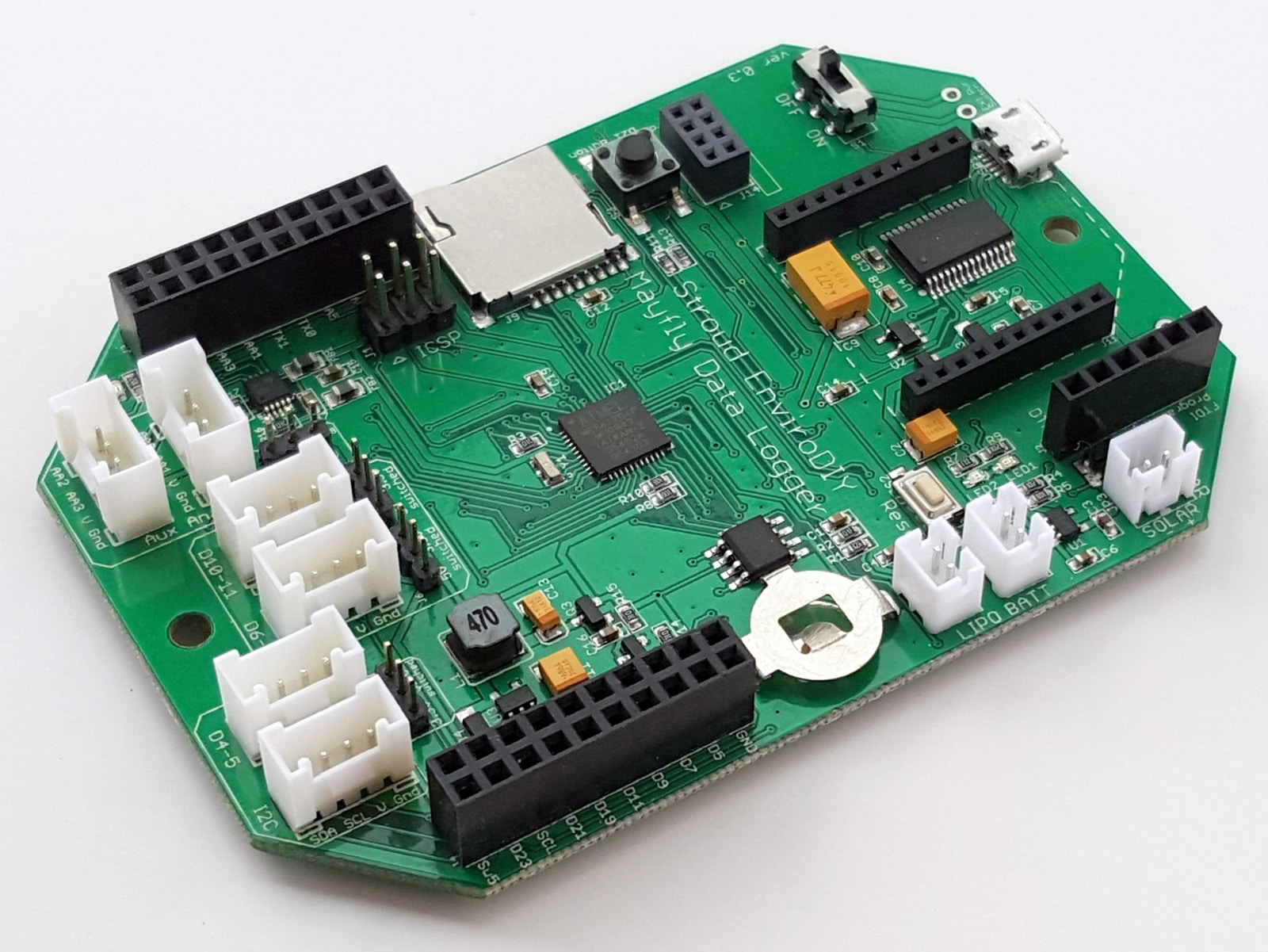
Here’s an update for everyone wondering about the board availability. We went through one more round of design updates to add some extra features like an onboard FTDI-USB chip and a 5-volt boost regulator to generate 5v for any sensors or devices you want to power. The final Mayfly production run should be ready for purchase at an online retailer in about a month from now (early March). More updates will follow soon.
Can’t wait….Can you tell us which online retailer ? The 5V boost will be really useful. I’m using several Mbili with power boost to 5V to power long 1-wire sensor bus.
They are being manufactured right now, but we can’t announce availability and online store info until everything is finalized. There was a slight slowdown in the process due to the holiday in China and its effect on the supply chain, but we’re still hoping to have them for sale very shortly.
The boards are now available on Amazon: http://envirodiy.org/mayfly-boards-now-available-on-amazon/
Any update on Mayfly availability? Thanks!
And a second request for update…desperate to get my hands on one (or more)…
We’re still waiting for the first big manufacturing run to get delivered. Once it does, we’ll get it to the distributor as soon as we can. In the meantime, we’ve been working on documentation and instructions, so look for postings that info on this site early next week.
Good news – the boards finally arrived a few days ago, I’m now working on getting everything ready for the online sales, details to follow shortly!