
 Welcome to EnviroDIY, a community for do-it-yourself environmental science and monitoring. EnviroDIY is part of
 If an EnviroDIY Monitoring Station is located in an area with sparse vegetation and little tree cover (i.e. open field, golf course etc.) with access to direct sunlight for more than an hour each day, a small 3.7 V 2500 mAh lithium ion battery will be sufficient to power the station (Figure A.1).
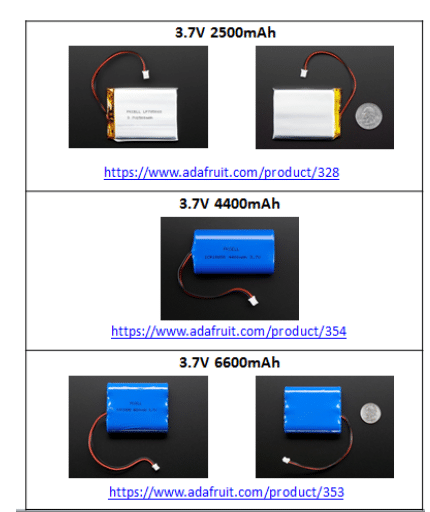
For use in a moderately sunny area where there is more vegetation and tree cover prevalent, a 3.7 V 4400 mAh lithium ion battery will be necessary (Figure A.1). This is the standard choice for the Mayfly Data Logger station, and will be sufficient in most scenarios. This battery can usually last about two or three weeks without a solar panel connected, depending on the cellular signal in the area.
For use in heavily wooded locations where shade dominates most of the year (i.e. abundant evergreen vegetation) or in situations where the logger station needs to be hidden (i.e., no solar panel cannot be used) a 3.7 V 6600 mAh lithium ion battery will be needed (Figure A.1).
The solar panel that is most often used for the EnviroDIY Data Logger station is a 6 Volt, 5 Watt solar panel created by Voltaic Systems. They are made of a rugged, waterproof material which makes them suitable for long-term outdoor use.
Typically, one of these solar panels will fully charge a battery in a few hours if there is access to direct sunlight. Depending on site specific conditions, smaller or larger solar panels may be necessary. If a station is located in an area that has more than average sunlight (i.e. an open field with little vegetation) a 2W solar panel will be sufficient to fully charge the logger station’s battery. However, If a station is located in an area with extremely dense vegetation and very little sunlight a 10W solar panel will be necessary. These different size solar panels can all be attached to the Mayfly Data Logger using the same universal solar panel bracket from Voltaic Systems and a U-bolt with associated hardware.
For more information, see this page for EnviroDIY Mayfly Logger Battery Options.